По теме
Персонализация сообщений для убеждения и манипуляции: психол...
Глубокий анализ того, как персонализация сообщений на основе личностных черт и ИИ используется для у...
Психическое здоровье мужчин: как помочь близким мужчинам отк...
Подробное руководство о том, как начать разговор с мужчиной о его психическом здоровье. Эксперты из ...
Как удовлетворение потребностей автономии, компетентности и ...
Исследование показывает, как удовлетворение базовых психологических потребностей влияет на отношение...
Как помочь мужчине открыться: эффективные стратегии разговор...
Подробное руководство по запуску честных диалогов с мужчинами о их ментальном состоянии. Эксперты MH...
Юмор как инструмент выживания в кризисе: наука о смехе в ком...
Глубокий анализ научных исследований роли юмара в преодолении кризисов рабочими группами. Рассмотрен...
Как искусственный интеллект имитирует человеческий мозг: ана...
Подробный разбор того, как глубокие нейронные сети соотносятся с активностью головного мозга человек...
Как модели LLM могут мыслить как врачи: возможности модели o1
Недавно опубликованное исследование модели OpenAI «o1» дает уникальный взгляд на меняющуюся роль искусственного интеллекта в медицине. Ученые обнаружили, что «o1» показывает результат, превышающий GPT-4 в медицинском вопросно-ответовом формате в среднем на 6,2%, что указывает на то, что это улучшение не связано просто с увеличенной вычислительной мощностью. В центре этого прогресса лежит способность модели применять метод цепочки рассуждений (Chain-of-Thought, CoT) — подход, который разбивает сложные медицинские запросы на итеративные шаги, напомимая нюансированное мышление врача. Есть еще больше в этой истории: CoT может стать ключом к будущему ИИ в клинической практике.
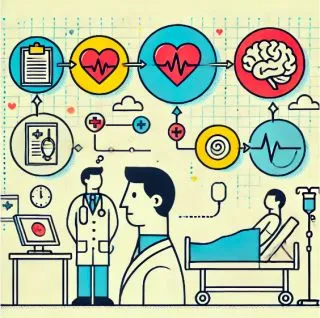
Динамический процесс клинического диалога
В клинической практике диалог inherently динамичен. Врачи engaging in a complex interplay of data gathering, hypothesis generation, and critical evaluation. They adapt to new information in realtime, often refining their understanding of a patient's condition with each interaction. CoT enables «o1» to do something remarkably similar: it processes a medical question in segments, allowing it to consider various aspects methodically before arriving at a comprehensive answer. This approach transforms AI from a mere information repository into a tool that mirrors the intellectual complexity of clinical dialogue.
Переход к практической пользе ИИ
Введение CoT как фреймворка рассуждений внутри «o1» сменяет то, как мы воспринимаем возможности ИИ в сфере здравоохранения. Одним из ключевых преимуществ является то, что оно позволяет клиникам использовать более простые промпты для взаимодействия с моделью. Раньше модели ИИ требовали высокоструктурированных входных данных для получения точных ответов, требующий уровень специфичности, который часто ограничивал их утилизуемость в реальной клинической практике. «o1» однако использует CoT для эффективного навигации промптов, отражая нюансированный и часто непредсказуемый характер медицинских обсуждений. В некотором смысле это имитирует то, как врачи приходят к диагнозам — не линейчно, а через синтез симптомов, истории пациента и evolving evidence.
Когнитивное преимущество ИИ:Beyond Question-Answering
Потенциал этого «когнитивного преимущества» в медицине выходит за пределы простого вопросно-ответного взаимодействия. По мере того как модели ИИ вроде «o1» становятся более adept на навигацию по сложной медицинской информации, они вводят возможность более meaningful contributions to clinical settings. Например, на утренних кругах или консультациях, «o1» мог бы выступать в роли системы поддержки, предлагая дифференциальные диагнозы, suggesting evidence-based treatments, или даже highlighting recent research relevant to a specific case. Its ability to provide clinical reasoning opens new doors, where AI might not just assist in diagnosis but actively participate in treatment planning and patient communication.
К будущему, обогащенному ИИ в клинической практике
Это критический шаг к практической утилизации ИИ в клинических средах. Итеративное, CoT-driven рассуждения,employed by «o1», resembles the collaborative problem-solving found in medicine, offering an approach that can adapt to the context and demands of patient care. It’s not about AI replacing clinicians; rather, it’s about AI becoming a more integral part of the clinical toolkit. By embodying elements of clinical dialogue, AI can evolve into a dynamic partner—an informed assistant capable of enhancing decision-making, streamlining workflow, and potentially improving patient outcomes.
Может ли это быть рассветом ИИ-врача?
Возможно, не в смысле автономного врача, но точно как essential assistant — или, как говорят, партнер. Подражая рассудочным процессам человеческих врачей, модели вроде «o1» сигнализируют о новой фазе в внесении вклада ИИ в медицину. Его появление как Large Reasoning Model suggests a future where AI can not only inform but also engage in the nuanced, context-rich dialogues that define good medicine. This transformation hints at a future where AI becomes less of a tool and more of a partner in the complex journey of patient care.
"AI will not replace physicians, but physicians who use AI will replace those who do not."
Study confirms that the integration of reasoning frameworks like CoT can bridge the gap between raw data processing and meaningful clinical insight. As AI models continue to evolve, their role shifts from passive knowledge bases to active participants in patient care. The iterative nature of CoT allows for continuous refinement of hypotheses, mirroring the real-time decision-making process of experienced physicians. This shift is particularly significant in specialties where differential diagnosis and treatment planning require synthesizing vast amounts of patient-specific data.
- Chain-of-Thought (CoT): метод рассуждений, разбивающий задачи на шаги
- Large Reasoning Model (LRM): Large Language Model, optimized for logical and medical reasoning i>Differential diagnosis: дифференциальная диагностика — перечисление возможных причин симптомовi>Evidence-based medicine: доказательная медицина — подход, основанный на клинических доказательствах
Clinical trials and observational studies already demonstrate that AI-assisted decision support can reduce diagnostic errors by up to 15%. With the advent of models like «o1», these numbers have the potential to improve further, as the model's ability to think in steps allows it to catch subtle inconsistencies in patient history or lab results that might be overlooked in a single-pass analysis. Moreover, the ability to process prompts in a more natural, less rigid format means that clinicians can interact with AI assistants more fluidly, without having to craft perfect, highly structured queries every time.
The implications extend beyond the hospital walls. In telemedicine, remote monitoring, and even primary care settings, AI with CoT capabilities can serve as a first-line triage tool, guiding patients toward appropriate care while providing physicians with suggested next steps. This not only increases efficiency but also helps standardize care quality across different regions and facilities. As the technology matures, we may see AI playing a role in preventive medicine, identifying risk factors early, and suggesting personalized lifestyle or pharmacological interventions based on a growing evidence base.
However, the road ahead is not without challenges. Ensuring patient privacy, maintaining transparency in how AI reaches conclusions, and establishing clear regulatory frameworks are essential steps before widespread adoption. The study emphasizes that the goal is not to create an autonomous AI doctor, but to develop a trusted partner that enhances human expertise. By aligning AI reasoning with the collaborative, iterative nature of clinical dialogue, we move closer to a healthcare ecosystem where technology and humanity work in tandem to achieve better outcomes.
Ultimately, the success of AI in medicine will be measured by its ability to integrate seamlessly into existing workflows, respect the primacy of patient-physician relationship, and deliver tangible improvements in health outcomes. The o1 model represents a promising step in that direction, offering a glimpse of a future where AI is not just a tool, but a true partner in healing.
Заключение: будущее сотрудничества человека и ИИ в медицине
Исследование модели o1 OpenAI открывает новые горизонты в применении искусственного интеллекта в медицине. Благодаря внедрению метода цепочки рассуждений (CoT) система способна мыслить иначе, более akin к человеческому клиническому мышлению, что повышает точность ответов на 6,2% по сравнению с предыдущими поколениями моделей. Этот прогресс не обусловлен просто ростом вычислительных мощностей, а представляет собой смену парадигмы в том, как ИИ обрабатывает информацию — шаг за шагом, с учетом контекста и множества переменных.
Клинический диалог, по своей природе динамичен. Врачи непрерывно собирают данные, генерируют гипотезы и критически оценивают информацию, адаптируясь к новым данным в реальном времени. CoT позволяет модели o1 эмулировать этот процесс, разбивая сложные медицинские запросы на логические отрезки. Такой подход превращает ИИ из простого репозитория фактов в инструмент, способныйMirror the intellectual complexity of real medical practice.
Одним из самых значимых преимуществ использования CoT является снижение порога входа для клиницистов. Раньше для получения точных ответов от моделей ИИ требовалась экспертность в формулировании идеальных промптов, что ограничивало применимость технологий в суете клинической практики. Сейчас doctors can use simpler, more natural language prompts, and the model will still deliver nuanced, step-by-step reasoning. This mirrors how physicians actually work: not by issuing one-line commands, but by engaging in a dialogue, refining their understanding with each new piece of information.
The potential of AI to contribute to clinical settings is vast. In rounding situations, AI could suggest differential diagnoses, highlight recent peer-reviewed research, or even flag potential drug interactions based on a patient's full history. Its ability to provide reasoning, not just answers, means it can become an active participant in treatment planning and patient education. Imagine a scenario where during a consult, the AI proposes three possible diagnoses with supporting rationale, cites relevant studies, and asks clarifying questions — all in a format that feels natural to the practicing physician.
However, the transition to AI-enhanced clinical practice must be handled with care. Issues of data security, algorithmic bias, and the need for transparent validation remain paramount. The study makes clear that the goal is augmentation, not replacement. By embedding AI within the collaborative framework of clinical dialogue, we preserve the central role of the physician while leveraging the computational power and pattern-recognition strengths of machine learning.
Looking forward, the integration of CoT-driven reasoning into LLM architectures signals a maturation of the field. We are moving from an era where AI was measured by its ability to retrieve facts, to one where it is evaluated by its capacity for logical inference, contextual understanding, and meaningful collaboration. The o1 model, with its demonstrated improvements and reasoning capabilities, is a testament to this shift. It suggests a future where AI does not overshadow the clinician but walks beside them, offering insights, checking logic, and ultimately contributing to better, safer, and more personalized patient care.
As healthcare continues to embrace digital transformation, the dialogue between human expertise and artificial intelligence will only grow in importance. The key will be in designing systems that respect clinical workflows, honor patient autonomy, and enhance — rather than diminish — the art of medicine. The o1 study is more than a technical milestone; it is a roadmap toward a more integrated, intelligent, and human-centric future of healthcare.